Affiliate disclosure. Some articles on this site contain affiliate links. If you use one and book or buy something, I may receive a small commission; it costs you nothing extra. A commission never buys a recommendation — if something isn’t worth your money, the article says so. Full details in the privacy policy.
Start here
Find your situation. Each one is explained below.
This is an emergency. Fire and ambulance, same number. It works in English — there is an interpreter system behind it, and it has been running since 2017.
- You cannot tell if it is an emergency. The Tokyo Fire Department's own triage tool, the Tokyo EMS Guide, has an English version on the web. There is also #7119, a 24-hour medical team — but read that section before you dial it.
- You want to talk to someone in your language about where to go. Tokyo runs a free line, 03-5285-8181, from 9am to 8pm.
- It is the middle of the night and it is not an emergency. 050-3816-2787 — 24 hours, English, Chinese, Korean.
- You would rather search yourself, at any hour. The national database has an English version and a filter for clinics open right now.
There is an odd shape to this list, and it is worth naming up front. The emergency number is the one with documented language support. The "should I go in?" number is the one where nobody will commit to an answer. The English-language advice I found while checking this had it the other way round.
If it is an emergency: 119 works in English
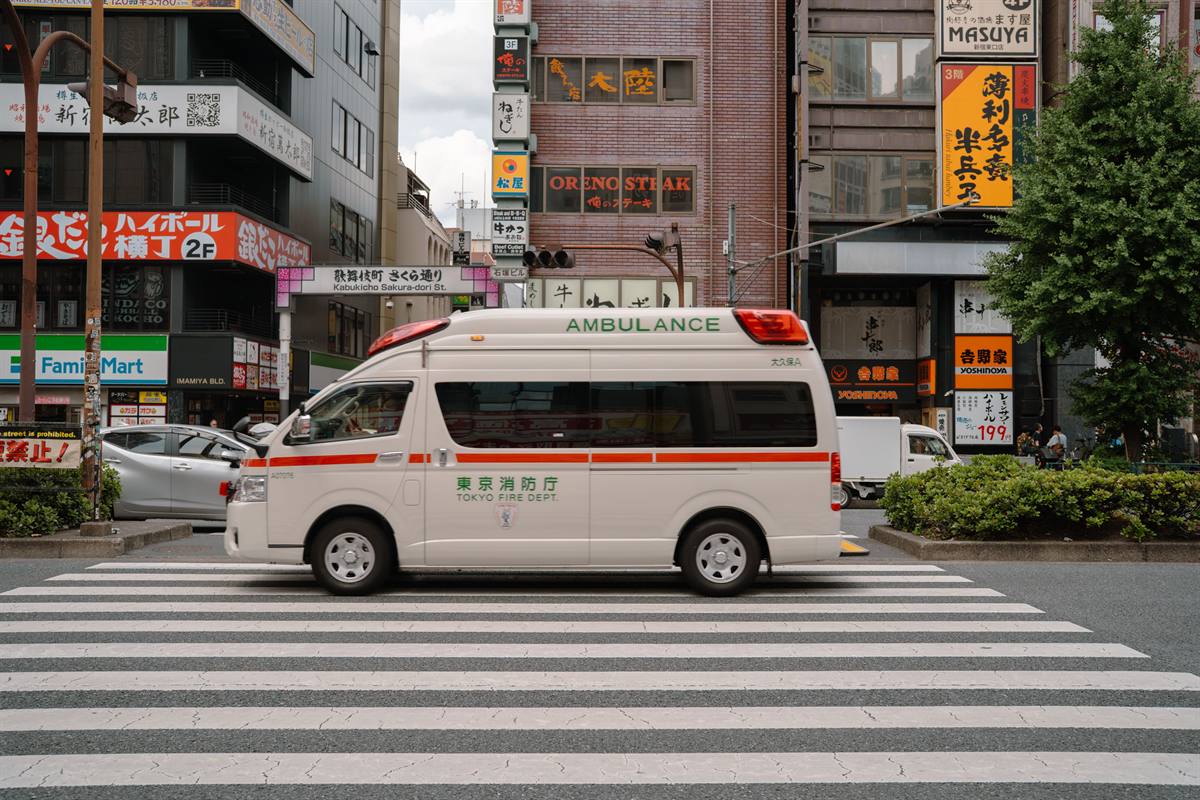
Call 119. The same number covers fire and ambulance.
The Tokyo Fire Department states that its dispatch centres — the Disaster and Emergency Information Centre and the Tama Disaster and Emergency Information Centre — have an English speaker on duty at all times.
On top of that, they run three-way simultaneous interpretation through a telephone interpreting centre, covering:
English, Chinese (Mandarin), Korean, Portuguese and Spanish. For other languages, the page says the interpreting contractor handles it as far as possible.
This has been in operation since 1 July 2017. It is not a pilot.
The first question is which service you need
The Tokyo Fire Department publishes the call as a script, and it opens with the operator asking:
消防庁です。火事ですか、救急ですか。
(Fire department. Is it a fire, or an ambulance?)
The answer for an ambulance is 救急です — kyūkyū desu. With an English speaker on duty, you should not need the Japanese, but that is the shape of the opening exchange, and it catches people who expect to launch straight into the problem.
You do not need to know the address
This is the part that matters most and appears almost nowhere in English.
The fire department's page says plainly that if you cannot give an address, you give it a landmark instead, and the operator finds you on a map. The examples it prints are:
- A building or shop name — "in front of the ◯◯ building in ✕✕ ward"
- A road or intersection — "the ✕✕ crossing on ◯◯ street"
- A station or bus stop — "◯◯ line, ✕✕ station, platform 2"
- A park, bridge or other public place
- The block-number plate fixed to poles and walls
There is one instruction attached to this, and it is easy to get wrong as a visitor:
通報の際には初めに区市町村から伝えてください。
(When you call, say the ward or city first.)
The reason is printed alongside it. Tokyo has the same place names in several different wards and cities — the page gives Fujimi-chō in Itabashi ward and Fujimi-chō in Hachiōji as its example. Starting with "Shibuya ward" or "Shinjuku ward" removes an ambiguity the operator would otherwise have to unpick.
Two more from the same page:
- Have your phone number ready. The crew may call you back.
- Do not switch your phone off until the ambulance arrives, for the same reason.
- Mobile signal is poor in underground shopping streets and tunnels.
Why to read this now rather than then: the address is the item that stalls the call. Knowing you can say "Ginza line, Asakusa station, platform 1" instead of an address you have never learned is the difference between an ambulance moving and a conversation going in circles.
What else they will ask
After the address, the fire department's script has the operator ask what has happened — who, and what is wrong with them — and then your name, with your phone number in some cases.
Tokyo Metropolitan Government's own page for foreign visitors gives a slightly longer list: that it is an emergency, the address, the symptoms, the person's age, and your name and contact number.
The two official lists do not match exactly — age appears on one and not the other. Neither is wrong; they are written by different bodies. Expect the four that both agree on, and have the age ready in case.
After the ambulance arrives
Every ambulance crew in Tokyo carries a multilingual voice translation app called Kyukyu VoiceTra, which covers 31 languages. It has been on every crew since July 2022.
Crews also carry a communication support board (6 languages) and a communication manual (11 languages), plus access to the same telephone interpreting service (5 languages).
Why this changes the calculation: the common worry — I can't call an ambulance, I don't speak Japanese — is not supported by what the fire department publishes. The language support is documented at both ends, the call and the crew.
One thing I cannot tell you
Whether the ambulance costs anything. None of the official pages I checked says — not the page explaining how 119 works, not the page on appropriate use of ambulances. I am not going to write "ambulances are free in Japan" on the strength of pages that do not say it.
If you are not sure: #7119
The Tokyo Fire Department is explicit about the split:
緊急性が高いと思った時は、「119」に電話して救急車を呼んでください。緊急性が高いかどうかわからない時や迷った時は、「#7119」を利用してください。
(If you think it is urgent, call 119 for an ambulance. If you do not know whether it is urgent, or you are unsure, use #7119.)
- Dial #7119 from a mobile, PHS or touch-tone line
- If short dialling does not work: 03-3212-2323 for the 23 wards, 042-521-2323 for the Tama area
- 24 hours, every day of the year
- Answered by a medical team — the page names doctors, nurses, and staff with ambulance-crew experience
And here is the gap. Across the pages for this service, there is no statement about what languages the operators handle — not that English is available, not that it isn't.
There is one piece of evidence pointing one way. The Tokyo Fire Department publishes an English page which tells English-speaking readers:
If you are unsure about your condition, call #7119. Operators are available 24 hours a day.
So the fire department is, in English, pointing English readers at this number. But read that sentence closely: it says operators are available around the clock. It does not say what language they answer in.
So: I will not tell you #7119 works in English, and I will not tell you it doesn't. If you are alone at 2am with no Japanese and you are genuinely unsure how bad this is, the section below is the better first move.
The English tool that answers the same question
The Tokyo Fire Department also runs the Tokyo EMS Guide, and there is an English version on the web.
It is built for exactly the situation #7119 exists for. In the fire department's own words, it is:
An integrated service designed to assist individuals who are uncertain whether they should visit a medical facility or call an ambulance due to a sudden illness or injury.
You enter what is going on, it assesses the level of urgency, and if you do need to be seen, it will search for medical institutions near you.
Why this may be the single most useful link here: it is the fire department's own triage logic, in English, on a web page. No phone call, no language gamble, no opening hours. If you are awake at 3am trying to decide whether this is an ambulance situation, this is the thing to open first.
The line that speaks your language — until 8pm
For everything short of an emergency, Tokyo runs a medical information service for foreign patients.
- Phone: 03-5285-8181
- Every day, 9am to 8pm, 365 days a year
- English, Chinese, Korean, Thai and Spanish
- Free. You pay only for the call
Tokyo's page lists what it is for: which medical institutions can see you in your language, roughly what treatment costs if you have no insurance, and how the Japanese medical system works.
Why this is the best of the non-emergency options: five languages, and the answers come from the body that licenses the hospitals.
And why the closing time matters: at 8pm that ends, and the next two sections exist because of it.
There is also a 24-hour medical institution guidance line, Himawari, on 03-5272-0303. Note it is a different number from the multilingual one — Tokyo lists the two as separate services, and the pages do not state which languages the 24-hour line handles. Tokyo's own page adds a warning worth repeating: clinic information changes, so call the clinic itself before you set off.
After 8pm, and not an emergency
Japan Visitor Hotline: 050-3816-2787
- 24 hours a day, every day
- English, Chinese and Korean
- Covers emergencies including illness, and it will refer you to medical institutions that work in foreign languages
It sits on the site of JNTO, the national tourism organisation, though the page itself credits the Japan Tourism Agency — which is exactly why someone searching for a medical number never finds it.
Why to save it now: between 8pm and 9am, for something that is not an ambulance call, this is the number where the official pages state in writing that you will get English, Chinese or Korean.
Searching it yourself: Navi-i
The Ministry of Health, Labour and Welfare runs a national database of hospitals, clinics, dental clinics and pharmacies: Medical Information Net (Navi-i).
- There is an English version, plus Chinese (simplified and traditional) and Korean
- You can filter by foreign language — it is a standard search category
- You can filter for "open now" and for holiday and night-time care
- Phone line: 0570-000692
Since April 2024, Tokyo's own web search folded into this national system, so this is where the Tokyo listings live now.
Why to open it before you need it: learning a government database interface for the first time, on a phone, while you feel terrible, is not the plan.
Buying medicine at a drugstore
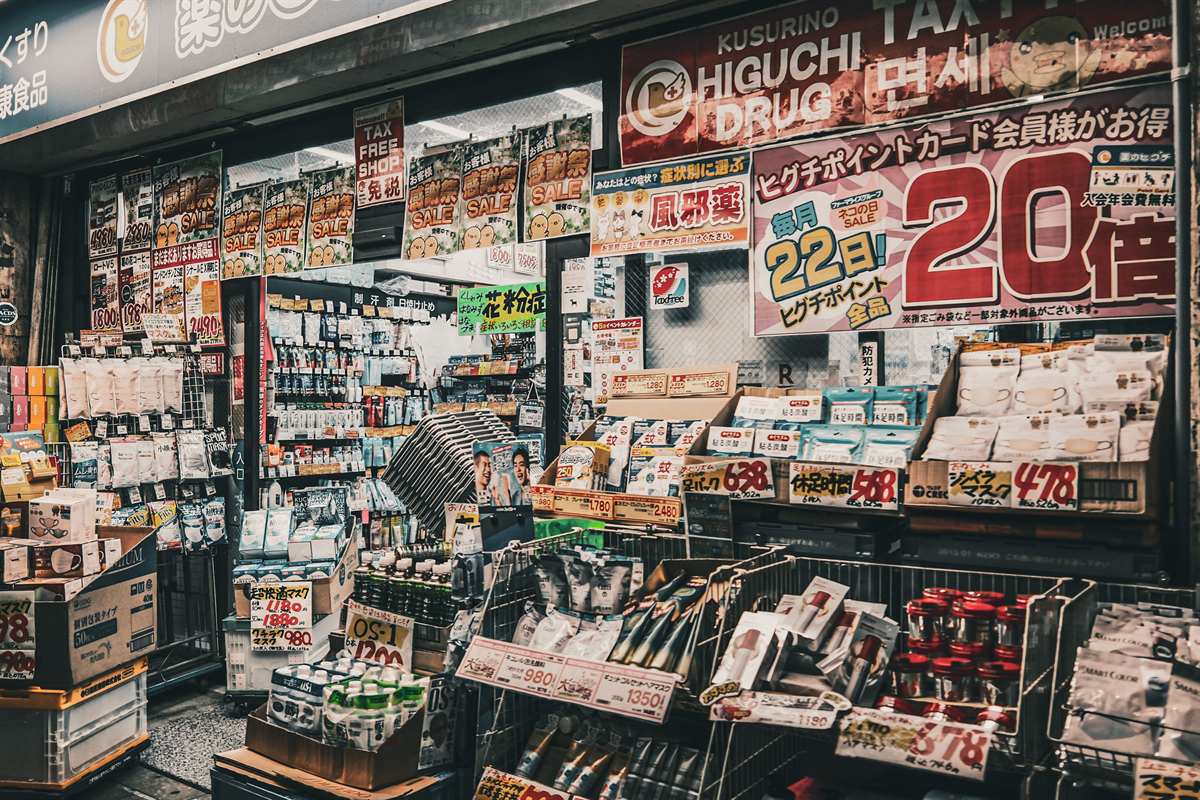
Two things are worth knowing before you walk in. One is why some boxes sit behind a counter. The other is that since May 2026, buying cold and cough medicine involves being asked questions.
Why the box you want is behind the counter
Japanese over-the-counter medicine is sorted into classes, and the class decides who has to serve you.
| Class | Who serves you | Where |
|---|---|---|
| Yō-shidō (guidance-required) | Pharmacist | Pharmacy only |
| Class 1 | Pharmacist | Pharmacy or retail |
| Class 2 (incl. designated Class 2) | Pharmacist or registered seller | Pharmacy or retail |
| Class 3 | Pharmacist or registered seller | Pharmacy or retail |
For guidance-required and Class 1 medicines, giving you the information is mandatory — the pharmacist has to explain, whether or not you ask. For Class 2 it is a duty to make the effort. For Class 3 there is no such requirement.
The part worth knowing: for every class, if you ask a question, answering it is mandatory. Asking is not an imposition. It is the one thing the rules guarantee you.
Guidance-required medicines used to be face-to-face only. Since 1 May 2026 a pharmacist may handle that consultation over video call instead, and one narrow group — emergency contraception — still requires it in person. I have this from prefectural health authorities summarising the change rather than from the Ministry notice itself.
Cold and cough medicine: expect to be asked questions
This is new, it started on 1 May 2026, and it will catch you off guard if nobody has mentioned it.
A set of ingredients is now designated under a national anti-misuse rule. They appear across ordinary cold remedies, cough syrups, hay-fever tablets, decongestants and sleep aids — ephedrine, pseudoephedrine, methylephedrine, codeine, dihydrocodeine, dextromethorphan, diphenhydramine and bromovalerylurea. Nothing exotic. These are the boxes a visitor with a blocked nose reaches for.
When you buy one, the pharmacist or registered seller is required to ask:
- Your age. If they can see you are clearly over 18 your word is enough; if they cannot tell, they may ask for ID. Worth knowing if you look younger than you are.
- What else you are taking — other medicines, prescription or otherwise.
- Whether you have bought this sort of thing recently, here or at another shop.
- Why you want more than one, if you are buying more than one.
- What it is for — your symptoms.
They also have to tell you, in writing, that misuse can harm you, and check that you understood. The writing can be a laminated card at the till. This is not suspicion. It is a checklist they are legally obliged to work through.
The trap: "more than one" does not mean two identical boxes. If two different products contain the same designated ingredient, buying one of each counts as buying two, and the reason question applies. A cold remedy and a cough syrup can easily share an ingredient. Even with different ingredients, the shop may ask about the combination.
Buying more than one has a second consequence. For an adult, a large pack or multiple packs cannot be sold through an ordinary web order — the conversation has to happen in person or over video. Single small packs are the only case where a plain online purchase is allowed.
Under 18, large or multiple packs cannot be sold at all, and even a single small pack needs the conversation in person or by video.
And you can be refused. The rules anticipate it — shops are told to prepare a printed notice explaining that the refusal comes from the law, not from them. If it happens, it is not personal and arguing will not help.
Where these boxes are
Designated products in Classes 2 and 3 cannot simply sit on an open shelf. A shop has to either keep them locked away or out of reach, or place them within seven metres of a staffed information counter, in clear sight — not tucked behind a pillar or a tall shelf.
So if you cannot find the cold medicine, it is probably not out of stock. Ask at the counter.
One thing that has not changed: "online" here means a real-time video call. A phone call does not count. Nor does chat, or a form. If a website offers to sell you these without one, something is off.
On sources for this section: the classification table comes from a Ministry reference paper dated March 2026, except the guidance-required row, which reflects the change that took effect on 1 May 2026. The rules on designated anti-misuse medicines come from the Ministry's own notice to prefectures. The list of ingredients is the one published as of February 2026 and the Ministry updates it, so treat it as indicative rather than final.
What it costs
Two different things can cost you money here, and they are worth separating.
The bill for treatment
JNTO's own page is blunt about the upper end. It gives an example of ¥7.5 to ¥10 million for surgery with a hospital stay, and recommends taking out travel insurance.
It also states this:
foreign visitors who fail to pay their medical expenses may be denied entry into Japan in the future
That is on a government tourism page, not in an insurer's small print.
The surcharge for walking into a big hospital
This one is far more likely to happen to you, and I did not find it mentioned in the English-language guides I checked.
Since the 2016 financial year, Japanese law has required large hospitals to charge an additional fee — senteiryōyōhi — to patients who turn up without a referral letter from another doctor. It is not discretionary — the rule requires the hospital to charge it.
As a visitor you will not have a referral letter. So if you pick the biggest, most reassuring-looking hospital and walk in, that fee is added on top of the treatment cost. The amount is set by each hospital, so I cannot give you a figure.
What to do with that: it is an argument for starting small. A clinic, or the place the multilingual line points you to, rather than the nearest university hospital. If you use the search database, note that it lists clinics and hospitals side by side — the smaller entry is often the cheaper visit for the same problem.
All of this is about walking in under your own power. Whether the same fee reaches people who arrive by ambulance is a separate question, and one I could not settle for Tokyo. It is not a reason to hesitate over calling 119.
One thing I still cannot tell you: whether the ambulance ride itself costs anything in Tokyo. No official page I could find says. I am not going to write "ambulances are free in Japan," because that sentence is doing more work than the sources support. Ibaraki Prefecture has charged a hospital fee since December 2024 to people brought in by ambulance when the call turns out not to have been urgent, and it states that non-residents are included. That is not Tokyo, and I have not checked whether Tokyo does anything similar — which is exactly why I am not making a blanket claim either way.
One caution about all of this
Official services existing is not the same as being seen.
Travellers do report being turned away, or told a clinic no longer takes foreign patients. The lines and databases here help you find somewhere that will see you. They are not a promise that the first place says yes. I have no way to check individual refusals against an official source, so I am not going to pretend the system runs more smoothly than the people using it say it does.
Line up more than one option, and start with the services built for foreign patients rather than calling the nearest hospital cold.
Quick version
| Emergency | 119 — fire and ambulance, same number. English speaker always on duty; interpretation in English, Chinese, Korean, Portuguese, Spanish |
| First question | "Fire or ambulance?" — for an ambulance, kyūkyū desu |
| No address? | Give a landmark: station and platform, intersection, building, park. Say the ward or city first |
| They will also ask | What happened · your name · your number (and possibly the person's age) |
| Keep your phone on | The crew may call back |
| Ambulance crew | Carries a 31-language translation app |
| Not sure if it's urgent | Tokyo EMS Guide — the fire department's triage tool, English version on the web |
| Same question, by phone | #7119 — 24h medical team. Operator language not stated either way |
| #7119 won't dial | 23 wards 03-3212-2323 · Tama 042-521-2323 |
| Your language, 9am–8pm | Tokyo, free: 03-5285-8181 — English, Chinese, Korean, Thai, Spanish |
| Your language, any hour, not an emergency | JNTO: 050-3816-2787 — English, Chinese, Korean |
| Find a clinic, any hour | Himawari 03-5272-0303 — languages not stated |
| Search it yourself | Navi-i — English version, filter by language and "open now" |
| At a drugstore | If you ask a question, they are required to answer. Ask |
| Cost trap | Large hospitals must charge extra if you have no referral letter. Start with a clinic |
| Before you go | Call the clinic to confirm. Tokyo's own page says so |
Facts, dates and sources
Facts on this page were checked against official sources on 26 August 2026.
Three things about the sources themselves, because they affect how much weight to give them:
- Tokyo's pages for the multilingual service carry old update dates — 25 March 2021 and 1 January 2023. The numbers and hours are exactly as printed, but worth confirming before you rely on them.
- JNTO's page carries no update date, and still refers to a COVID-19 call centre. Whether that part is current, I could not establish.
- The medicine classification comes from a reference paper attached to a law revision. Its table says "current", but the revision is why the paper exists.
Official sources used
- Tokyo Fire Department — Tokyo EMS Guide (English, web version)
https://www.tfd.metro.tokyo.lg.jp/hp-kyuuimuka/en_guide/main/index.html - Tokyo Fire Department — 119番通報の仕組み (how 119 works, what is asked, landmarks, language support)
https://www.tfd.metro.tokyo.lg.jp/lfe/119/119.html - Tokyo Fire Department — 東京消防庁の救急隊 (ambulance crews and their translation tools)
https://www.tfd.metro.tokyo.lg.jp/ts/ems/page07.html - Tokyo Fire Department — 東京消防庁救急相談センター (#7119)
https://www.tfd.metro.tokyo.lg.jp/lfe/kyuu_adv/soudan-center.html - Tokyo Fire Department — 救急相談センターQ&A (119 vs #7119)
https://www.tfd.metro.tokyo.lg.jp/lfe/kyuu_adv/soudan-center-b.html - Tokyo Metropolitan Government, Bureau of Public Health — 救急車の呼び方
https://www.hokeniryo.metro.tokyo.lg.jp/iryo/iryo_hoken/medical_info/emergency_call - Tokyo Metropolitan Government, Bureau of Public Health — 外国人患者向け医療情報サービス
https://www.hokeniryo.metro.tokyo.lg.jp/iryo/iryo_hoken/gaikokujin/interpreter/himawari - Tokyo Metropolitan Government, Bureau of Public Health — 各種医療機関案内(急に病気になったら)
https://www.hokeniryo.metro.tokyo.lg.jp/iryo/sodan/komatta/kyuubyou/24h_annai - Ministry of Health, Labour and Welfare — 医療情報ネット(ナビイ)
https://www.iryou.teikyouseido.mhlw.go.jp/ - Ministry of Health, Labour and Welfare — 令和7年薬機法改正について(要指導医薬品関係)参考資料, 6 March 2026
https://www.mhlw.go.jp/content/11120000/001666648.pdf - Ministry of Health, Labour and Welfare — 指定濫用防止医薬品の販売等について (notice to prefectures), 26 December 2025
https://www.mhlw.go.jp/content/11120000/001628299.pdf - Tokyo Fire Department — 救急車の適時・適切な利用にご協力ください
https://www.tfd.metro.tokyo.lg.jp/lfe/kyuu_adv/tksei01.html - Ibaraki Prefecture — 救急搬送における選定療養費の徴収について
https://www.pref.ibaraki.jp/hokenfukushi/iryo/iryo/isei/sentei_ryoyohi.html - JNTO — For safe travels in Japan: Guide for when you are feeling ill
https://www.jnto.go.jp/emergency/eng/mi_guide.html
These are Japanese-language pages, and that is the point. The hours, the languages and the interpreter arrangements are printed there, and they do not match what English-language advice generally says.
Written in Tokyo. English is not my first language — see the about page. I would rather be plain and correct than smooth and wrong.
More from Tokyo Notes
Practical guides to Tokyo from someone who walks these streets every day – transit, neighborhoods, accessibility, and the small details that make or break a trip. Browse all articles →