Affiliate disclosure. Some articles on this site contain affiliate links. If you use one and book or buy something, I may receive a small commission; it costs you nothing extra. A commission never buys a recommendation — if something isn’t worth your money, the article says so. Full details in the privacy policy.
The packing decision nobody can make properly
Packing for Tokyo, you may have wondered whether to bring pyjamas. You look up your hotel, you read the English amenities page, and you find nothing that looks like sleepwear. So you pack a set.
All five of the big Japanese business hotel chains put sleepwear in the room. The problem is that between them they call it six different things, and the English versions of their own websites make it worse rather than better.
What it is called, in Japanese and in English
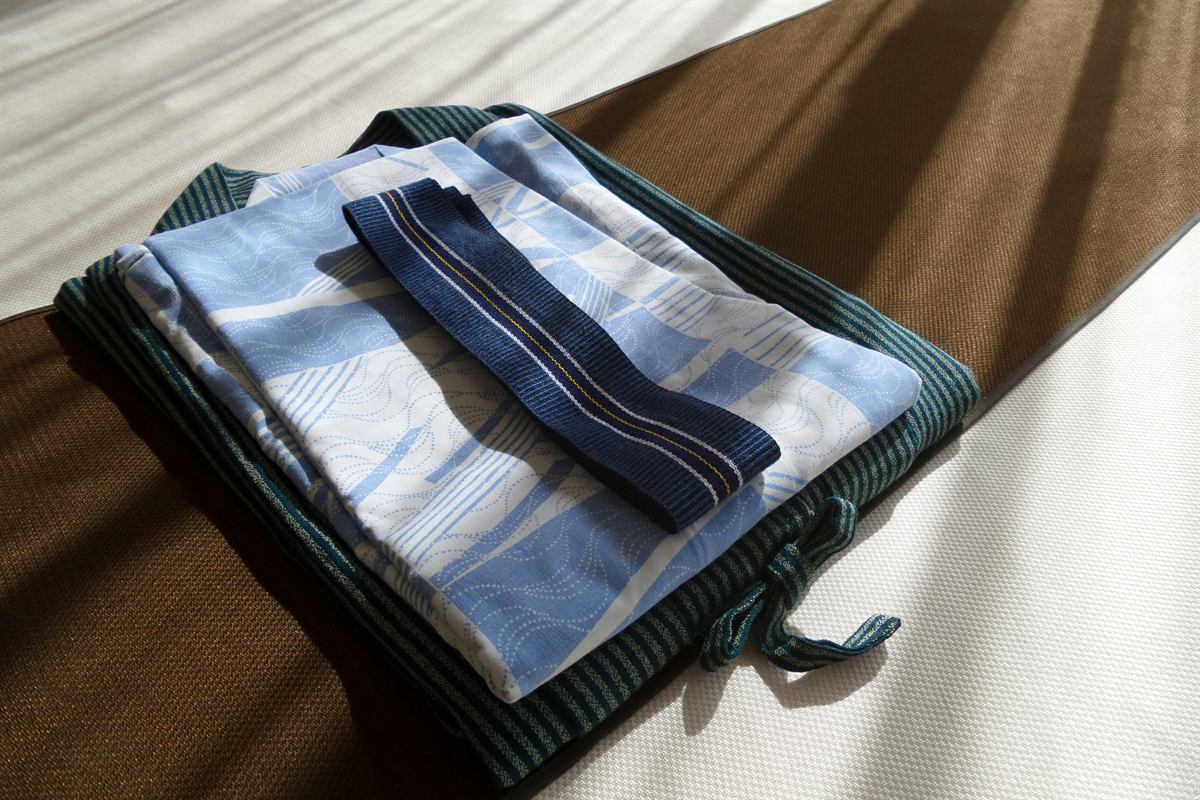
I checked the chains a visitor is most likely to end up in: Toyoko Inn, APA Hotel, Dormy Inn, Super Hotel and Route Inn. Here is what each one provides, and what its own English page calls it.
| Chain | Japanese | English page says |
|---|---|---|
| Toyoko Inn | ナイトウェア | Nightwear |
| Toyoko Inn | 館内着(浴衣) | yukatas / guest room loungewear |
| APA Hotel | 浴衣 / ナイトガウン | Yukata/Nightwear |
| Dormy Inn | 館内着 | indoor wear |
| Super Hotel | パジャマ/浴衣 | Pajamas / yukata |
| Route Inn | 甚平 | jinhei |
Only one of the five uses the word "pajamas" on its English page.
If you searched an English amenities list for "pyjamas" and found nothing, that is why. The garment was there. It was filed under loungewear, or indoor wear, or nightwear, or a romanised Japanese word.
The spelling that will not match anything
jinhei. Route Inn's English page uses this for what its Japanese page calls 甚平.
Everywhere else, that garment is spelled jinbei, with a b. The Japan National Tourism Organization spells it jinbei. Muji spells it Jinbei on both its European and American sites. So does Wasuian, a maker in Kiryu that has been producing them for decades.
None of them use jinhei. Search for it and you will find nothing, because nothing else is called that.
What you are looking for, if you want to know what will be on the bed: a jinbei is a two-piece set — a short-sleeved, kimono-style top with matching shorts, in Muji's description of the ones it sells. Route Inn does not describe the ones in its rooms, so I cannot tell you they are the same.
The word that misleads in the other direction
yukata is a real word with a real meaning, but for most visitors it brings to mind the rented festival kimono. On a hotel amenities page it means the thin cotton robe folded on your bed.
And the ones that sound like different things but aren't
loungewear, indoor wear, nightwear. These are three chains' attempts at the same category. It is worth knowing that loungewear is the word the tourism board and the manufacturers themselves reach for when explaining jinbei to an English reader — so when Toyoko Inn writes "guest room loungewear" and Route Inn writes "jinhei", they are closer to each other than the page makes them look.
Muji, which sells these things, files jinbei under "Pajamas & Loungewear." The hotels could say pajamas. Four of the five choose not to.
Why this matters more than it sounds: you are making a packing decision from a page that is technically complete and practically unreadable. Everything you needed to know was on it.
What you cannot find out in advance
What the garment in your room actually looks like. Of the five chains, only Super Hotel says in words whether its version is one piece or two — it calls it a separate type. Toyoko Inn and Route Inn show a photograph; the others show nothing. Nobody gives a length, a fabric or a size range.
So if you care about what you sleep in — a fit, a fabric, a two-piece — the official pages will not settle it for you, and I am not going to guess on their behalf. Pack your own if it matters to you. If it doesn't, there will be something there.
Laundry, briefly
Four of the five list a coin laundry: Toyoko Inn, APA, Dormy Inn and Route Inn. I could not find a mention of one on Super Hotel's chain-wide pages, which is not the same as saying there isn't one.
Dormy Inn is the only chain that publishes a price — washing free, dryer ¥100 for twenty minutes — and the only one that says detergent is dispensed automatically and included. The other three say it costs money, and stop there.
None of the five say how you pay.
That is a short section because there is not much to say. If you were wondering whether Japanese business hotels have laundry facilities, most of them do.
The honest summary
You do not need to pack sleepwear for a business hotel in Tokyo unless you are particular about what you wear to bed. It will be there. It may be a yukata, a jinbei, a two-piece set or a robe, and the English page may call it almost anything.
Facts, dates and sources
Facts on this page were checked on 27 August 2026 against the chains' own Japanese and English websites: Toyoko Inn, APA Hotel, Dormy Inn, Super Hotel and Route Inn. The spellings of jinbei were checked against the Japan National Tourism Organization, Muji and the maker Wasuian.
Two limits worth stating. I looked at chain-wide pages, not individual hotels — Toyoko Inn and APA both note that amenities vary by property, so your specific hotel may differ. And I have not stayed in these hotels; everything here comes from what the companies publish, which is exactly the point of the article.
Written in Tokyo. English is not my first language — see the about page. I would rather be plain and correct than smooth and wrong.
More from Tokyo Notes
Practical guides to Tokyo from someone who walks these streets every day – transit, neighborhoods, accessibility, and the small details that make or break a trip. Browse all articles →